
Behind Shein’s deliveries in Brazil: outsourced workers report health problems and humiliation
Repórter Brasil · Por Igor Ojeda
(há 7 horas)
Publicado originalmente em Repórter Brasil ↗ · Uso: CC BY-ND 4.0 (conteúdo jornalístico)

FROM GUARULHOS AND SÃO PAULO (SP) — “There is always someone feeling sick. Many people go without eating so they can meet their targets.” The account comes from an outsourced worker at Shein, the Chinese e-commerce platform whose sales in Brazil have grown sharply over the past five years.
She prepares goods for delivery at one of the multinational’s warehouses in Guarulhos, in the Greater São Paulo area. According to workers interviewed by Repórter Brasil, the job involves labeling products and moving them across the warehouse’s vast floor at a frantic pace.
Another employee, who says she previously worked at the same facility, describes a routine with no breaks: “I didn’t even stop to go to the bathroom. I even had to help people who were having anxiety attacks inside.” She now takes psychiatric medication, she says. “I’m no longer able to work for any company. There is no humanity there.”
“You’re not allowed to sit down. It’s eight hours of standing the entire time,” says a third worker.
Excessive working hours, inadequate workplace facilities, pressure to meet targets, irregularities in hiring practices, physical injuries and psychological abuse are among the accounts shared with Repórter Brasil by logistics workers serving Shein. Some have taken their cases to Labor Court. Those interviewed say they are not directly employed by the Chinese multinational, but by outsourced service providers.
In addition to the testimonies collected, Repórter Brasil identified hundreds of labor lawsuits against outsourced companies providing services to Shein through In Glow Brasil Intermediação de Negócios LTDA, one of the company’s legal entities in Brazil.
Repórter Brasil interviewed around 20 workers and analyzed 30 court cases. In at least ten rulings against service providers, the courts recognized Shein’s secondary liability.
This means the multinational may be required to pay amounts owed to workers if the outsourced companies fail to meet their obligations. The cases are still ongoing, and the rulings may be challenged through appeals.
Asked to comment, Shein said it “maintains policies and procedures for inspecting and monitoring service providers, with teams responsible for overseeing working conditions in logistics operations, including monitoring working hours, verifying the use of personal protective equipment (PPE) and ensuring compliance with occupational health and safety standards.”
The company also said it provides reporting channels for both directly employed and outsourced workers “to receive reports of possible irregularities, including cases of harassment, discrimination and other violations of its internal policies.” When irregularities involving outsourced companies are identified, Shein may require corrective measures “and, as appropriate, reassess the continuation of the contractual relationship.”
In its statement to Repórter Brasil, the multinational also said it is evaluating changes to work schedules as part of its “continuous improvement of working conditions” (read the full response here).
Workers are treated as ‘disposable,’ labor prosecutor says
Shein, known for selling low-cost clothing through the fast-fashion model, also sells products in other categories through a marketplace platform that brings together independent sellers.
Operating in Brazil since 2020, the company announced in September that it would expand its logistics operations in the country, with plans to hire 850 workers by December 2026.
“These platforms have a tremendous capacity to create jobs. However, these are not decent, dignified jobs, as advocated by the International Labour Organization,” warns labor inspector Renato Bignami, who holds a PhD in Labor Law and Social Security from the Complutense University of Madrid.
ASSINE NOSSA NEWSLETTER
Submit
Labor prosecutors, inspectors and researchers interviewed by Repórter Brasil say that the full delivery business model, which promises to bring products to customers’ doorsteps in a short period of time, is generally tied to abusive targets and routines that cause physical and mental exhaustion.
“These workers are treated as disposable. The [online retail] company’s priority is to keep operating. It doesn’t care who is providing the service, as long as the delivery is made within the expected timeframe,” says Geny Helena Barroso Marques, a labor prosecutor in Brazil’s Federal District.
According to fellow labor prosecutor Ana Gabriela Oliveira de Paula, the Labor Prosecutor’s Office is investigating how e-commerce platforms operate, but is still trying to understand their structure. “These are business relationships that are very different from what we used to see. It’s a new variation of the production chain,” she says.
‘I developed a urinary tract infection from holding it in’
“Drink some water, calm down and get back to work.” Júlia*, 47, says this was the advice given by her supervisors after she suffered anxiety attacks and needed help from colleagues while working as an outsourced employee serving Shein. She says she now takes psychiatric medication because of what she experienced in the workplace.
Shortly before 2 p.m., near the huge warehouse in the Cumbica neighborhood of Guarulhos — approximately 220,000 square meters, or 30 football fields — dozens of buses arrive carrying employees wearing uniforms bearing the words “Shein” or “Working on behalf of Shein.”
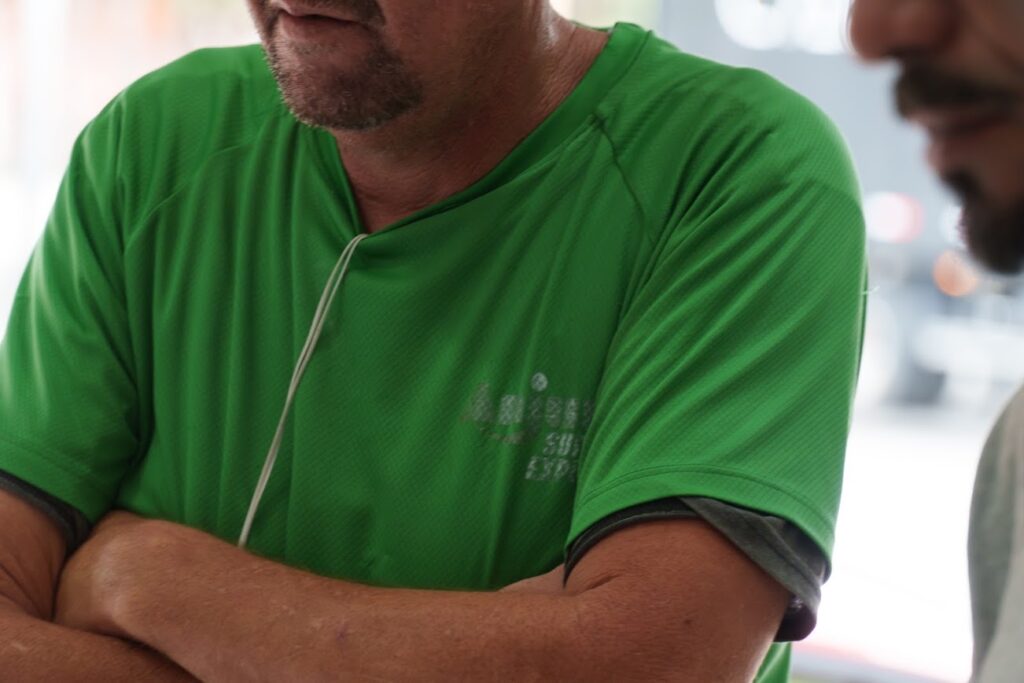
The vast majority, identifiable by green stripes on their shirts, are reportedly employed by different outsourced companies working for the Chinese multinational. A smaller group, identifiable by orange stripes, is reportedly directly employed by Shein, according to workers who spoke to the investigation team, which visited the site. When asked, Shein did not confirm this information.
Workers say the possibility of being hired directly by Shein is used by supervisors as a way to pressure them. The Chinese company itself advertises that it conducts performance reviews twice a year, which may lead to promotions. To “move up,” as workers put it, logistics assistants must meet targets that, according to them, put their physical and mental health at risk.
“I developed a urinary tract infection from holding it in. The bathroom is on the other side of the warehouse. If I stopped, I would lose too much time,” says Júlia*, who, after being dismissed, filed a lawsuit against In Glow Brasil Intermediação de Negócios LTDA and the outsourced companies Tallenty Serviços Empresariais and Manpower Staffing.
In its statement to Repórter Brasil, Shein said it “does not condone the use of the prospect of direct employment as a means of pressuring workers to meet productivity targets” and that, to date, it is unaware of any such incidents in its operations.
Manpower said it “complies with its legal and contractual obligations, ensuring that all hired professionals receive the rights provided for under the law.” Tallenty did not respond before this report was published (read the full responses here).

Women workers, who made up the majority of those interviewed near the warehouse, said they handle thousands of packages during a single shift while scanning orders (reading barcodes or QR codes).
One worker said she hides candy in her pockets to avoid feeling sick, since, she claims, she gets no breaks and eating at the workplace is prohibited. “There is always someone feeling sick because of low blood pressure or a drop in blood glucose levels,” says one of the assistants working at Shein’s warehouse in Guarulhos.
They also say that every day supervisors publicly display the names of employees who have met their targets and reprimand those who have failed to do so. “I felt inferior, incapable. I did my best, I was in pain, and no one supported me,” says Júlia. “If you don’t meet your target, they really come down on you. They humiliate you in front of everyone,” says another worker.
“Today, a colleague had an anxiety attack right next to me. We even thought she was having a seizure. There was no one there to help her,” another worker told Repórter Brasil outside the warehouse gates.
“He [the supervisor] kept rushing me. He said that everything there was about productivity and that I would get a formal warning,” says another assistant who worked at the same facility. After being dismissed, she also filed a lawsuit against outsourced company Flogistics Brasil Logística e Transporte, a company linked to Shein, and In Glow.
Flogistics did not respond before this report was published.
‘I used to keep two packs of painkillers in the truck’
“We prefer to use the bathroom at the shopping mall across the street. It’s more hygienic,” says João*, one of the drivers working for Anjun, a Chinese multinational transportation and logistics company that provides services to In Glow, Shein’s legal entity in Brazil.
Near Anjun’s warehouse in the Mooca neighborhood of São Paulo, workers complain not only about dirty bathrooms but also about inadequate facilities in the site’s dining areas. “There’s a horrible smell. The refrigerator is full of spoiled food,” one of them told Repórter Brasil.
Between 2024 and 2026, Anjun was fined at least five times by the Ministry of Labor and Employment for labor violations at its Mooca facility, including excessive working hours, rest periods of less than 11 hours between shifts and failure to provide the mandatory 24-hour weekly rest period, according to documents obtained by the investigation.
Drivers also say their shifts start at 10 a.m. and continue past midnight. They report unexplained deductions from their wages, driving trucks that are not properly maintained and working without the minimum rest period between shifts.
They also say they are required to load and unload tons of merchandise on their own. To do so, they claim, the company does not provide them with personal protective equipment (PPE). One worker has visible scars on his hands from cuts he says he suffered while unloading products without gloves.
Pedro* says he used to handle around 7,000 packages a day, equivalent, he estimates, to three tons. “I was in pain every day. I used to keep two packs of painkillers in the truck,” he says. He bought a trolley with his own money to help load and unload the packages.

All eight drivers interviewed by the investigation said they experienced pain on a daily basis. Hernias, tendinitis and spinal problems were among the health issues they mentioned. They also reported psychological distress, which they associate with pressure from their superiors. “I was starting to go crazy in there, and I was getting into fights with everyone out on the street,” one of them said.
When they question Anjun about their rights or refuse to work overtime, they say they are “punished”: sometimes they go many days without being assigned delivery routes, sitting on wooden benches outside the warehouse. On the day Repórter Brasil visited the site, five workers were in this situation.
“I’ve been going through this for more than a month. What they say is: ‘If you don’t like it, quit!’” Another worker asks: “It really messes with your head. Imagine sitting here in the sun, in the rain, all day long.” Six of the drivers interviewed have already filed lawsuits against Anjun and In Glow.
“The workers we have been seeing stay at these companies for very little time because they soon start developing shoulder and back problems, among other conditions. The level of neglect is astonishing,” says physician Maria Maeno, a researcher at Fundacentro/SP (Jorge Duprat Figueiredo Foundation for Occupational Safety and Medicine) and a specialist in workers’ health.
Asked by Repórter Brasil for comment, Anjun said that practices compromising workers’ dignity, health or rights are unjustifiable and that, therefore, “if conduct incompatible with these principles is identified, the cases should be handled by the relevant departments, with appropriate measures taken.” The company did not disclose the current number of workers providing services to Shein.
Shein said that “the company is part of its network of logistics service providers and that the contractual relationship includes clauses relating to compliance with applicable labor obligations.”
‘It is a subcontracting chain at every stage’
According to experts interviewed by Repórter Brasil, outsourcing and high employee turnover are defining features of Shein’s business model, which is based on e-commerce, on-demand production and fast deliveries.
These characteristics make production chains harder to trace and weaken labor relations, the experts say. “The contractual arrangements applied to these categories of workers are highly downgraded, flexible, precarious and unstable,” says Mateus Oliveira dos Santos, a researcher at the Observatory of Digital Platform Work in Brazil, at the University of Campinas (Unicamp).
The labor lawsuits analyzed by the investigation, for example, were filed by workers employed by companies subcontracted by Shein who worked in different areas. Logistics accounts for the largest number of cases identified, but there are also lawsuits involving sales, marketing and customer service professionals.
“This is the strongest defining feature of platformization: it is a subcontracting chain at every stage. It is structural, because it is also a way of maneuvering around labor disputes,” says Ricardo Festi, a professor in the Department of Sociology at the University of Brasília (UnB). He is currently researching Shein’s corporate structure.
Under this model, experts say, workers are scattered across different occupational categories, making it harder for them to organize and secure union representation. “They are employed by internet companies, e-commerce businesses or companies involved in trade and logistics,” says Santos. “As a result, the unions representing them are fragmented, because each outsourced company hires workers under different arrangements,” he adds.
“It doesn’t matter whether the company is outsourced. The company not only has the ability but also the obligation to monitor that environment to prevent its contractors from committing these violations,” says labor inspector Renato Bignami.
Shein’s expansion in Brazil and the challenges of labor inspection
Shein entered the Brazilian market in 2020, selling clothing manufactured in China. In 2023, following an agreement with the President Lula administration, it announced plans to invest US$150 million to begin manufacturing in Brazil. One way of doing so would have been through a partnership with Coteminas (Companhia de Tecidos Norte de Minas), involving 2,000 garment manufacturers.
The strategy did not work out, however. A Reuters report interviewed former manufacturers in Shein’s supply chain, industry representatives and union leaders, who said they had withdrawn from the partnership because the Chinese multinational allegedly demanded that local suppliers lower their prices and deliver orders faster than they were able to. The partnership with Coteminas also appears never to have materialized, according to media reports.
Shein then began selling products from Brazilian entrepreneurs through its marketplace system. “They achieved their target of having 85% of the products on their platform manufactured in Brazil. But they are not produced under Shein’s system,” explains Festi. “It is a different strategy from the one the company uses in other countries around the world. Everywhere else, production takes place in China, with products sold directly to consumers,” he says.
Experts are calling for regulation of the sector. “There needs to be a program that considers logistics infrastructure for Brazil and ensures these services are regulated, so that they operate in a way that is regulated, inspected and visible,” Santos concludes.
* Names have been changed to protect the sources’ identities.

25 anos investigando para mudar.
A Repórter Brasil já ajudou a impulsionar leis, fortalecer direitos e combater o trabalho escravo.
Em 2026, fazemos 25 anos — e vem muito mais por aí!
Leia também
The post Behind Shein’s deliveries in Brazil: outsourced workers report health problems and humiliation appeared first on Repórter Brasil.